

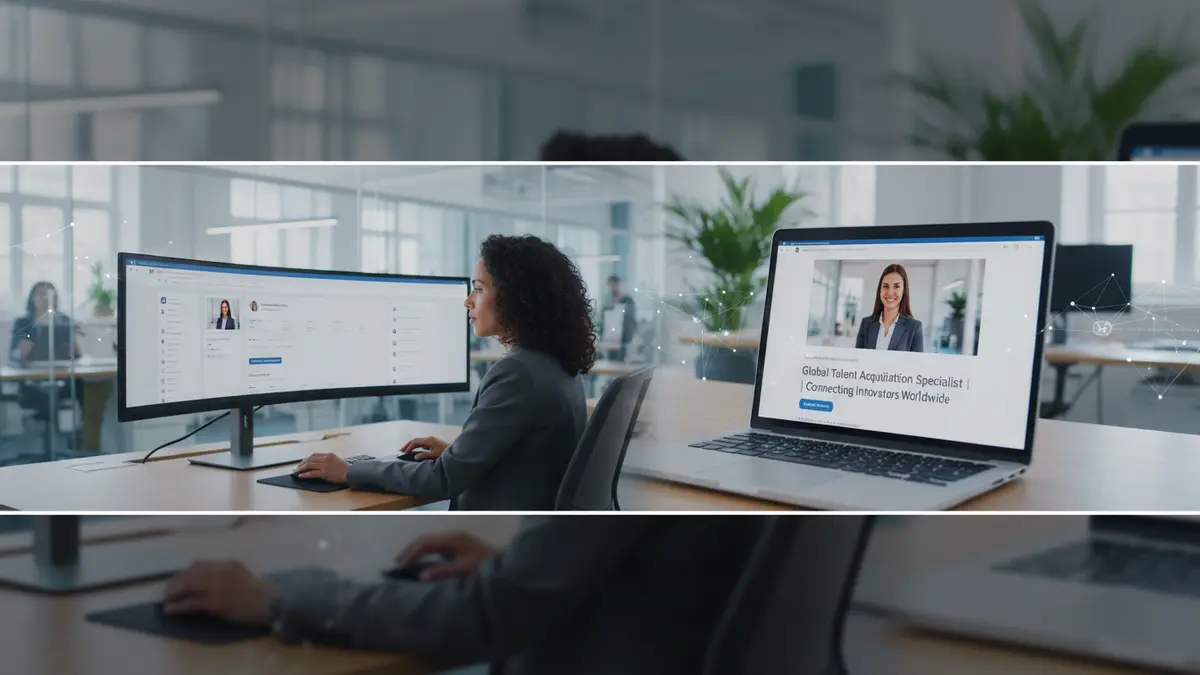
Imagine a recruiter in New York, London, or Sydney. They have a high-paying, fully remote role to fill and just 30 seconds to scan your LinkedIn profile. Will they see a generic job title and a sparse summary, or will they see a global-ready professional who can deliver value from anywhere in the world?
In the competitive 2026 remote job market, your LinkedIn profile isn’t a digital resume; it’s your international work visa, your marketing brochure, and your first interview all in one. To catch the eye of recruiters filling premier roles in Tier A countries, you need to think like they do. This guide provides actionable strategies, straight from the perspective of international talent acquisition experts, to transform your profile into a magnet for top-tier remote opportunities and truly maximize LinkedIn remote potential.
Related Stories




Craft Your Headline and Summary: Your Global First Impression
The space right below your name is the most valuable real estate on your LinkedIn profile. A recruiter’s decision to scroll down or click away often happens right here. It’s time to ditch the generic “Software Engineer at XYZ Corp” and craft a headline that screams value and remote-readiness.
Think of your headline as a value proposition. It should instantly answer three questions for a recruiter: Who are you? What value do you bring? What are you passionate about? Incorporate keywords that align with the roles you’re targeting.
Before: Project Manager
After: PMP-Certified Senior Project Manager | Delivering Complex SaaS Implementations for Global Tech Firms | Remote & Agile Expert
This revised headline is packed with searchable keywords (PMP, SaaS, Agile), specifies your seniority and industry, and explicitly states your expertise in remote work. It tells a recruiter a complete story in a single line. This is a foundational step covered in any comprehensive Optimizing LinkedIn for Remote Jobs 2026 guide.
The “About” Section: Tell Your Remote Work Story
Many professionals treat the “About” section as a copy-paste of their resume’s objective statement. This is a massive missed opportunity. International recruiters are looking for more than just skills; they’re vetting for a remote-first mindset. This is your space to narrate your career story, emphasizing autonomy, cross-cultural communication, and quantifiable results.
Structure your summary in three parts:
- The Hook: Start with a powerful 1-2 sentence summary of your professional identity and what drives you. Example: “As a data scientist with over 8 years of experience, I thrive on transforming complex datasets into actionable business strategies that drive growth for global FinTech companies.”
- The Evidence: Use 2-3 short paragraphs to highlight your key achievements. Don’t just list responsibilities; showcase results with numbers. Instead of “Managed social media campaigns,” write “Spearheaded a multi-channel digital marketing strategy across three continents, increasing lead generation by 250% and reducing cost-per-acquisition by 40% in 18 months.”
- The Remote-Ready Closer: End by explicitly stating your focus on remote work and mentioning key remote collaboration skills. Example: “Seeking a fully remote Senior Data Scientist role where I can contribute to a forward-thinking team. Proficient in asynchronous communication workflows using tools like Slack, Asana, and Jira, and experienced in collaborating effectively across multiple time zones.”
Strategic Keywords: How International Recruiters Find You
Recruiters don’t browse LinkedIn; they hunt. They use powerful search filters and Boolean strings to pinpoint ideal candidates. If your profile isn’t seeded with the right keywords, you’re invisible. Your profile needs to be optimized for both the LinkedIn algorithm and the human recruiter.
Think about the terms a recruiter in the UK would use to find a renewable energy expert or a Canadian tech company would use to find a software developer. Your profile’s Skills, Experience, and About sections should be rich with these terms.
Essential Remote Work Keywords for 2026:
- General: Remote Work, Distributed Team, Global Teams, Work from Anywhere, Asynchronous Communication, Time Zone Management.
- Tools: Slack, Jira, Asana, Trello, Miro, GitHub, Zoom, Microsoft Teams.
- Methodologies: Agile, Scrum, Kanban, Lean, DevOps.
- Industry-Specific: For tech, include programming languages and cloud platforms (Python, AWS, Azure). For healthcare, mention telemedicine, HIPAA, and virtual patient care. For green energy, include terms like ‘solar project management’ or ‘wind turbine data analysis’. This is especially crucial for specialized fields like AI-driven remote roles.
Go to the “Skills” section and add at least 20 relevant skills, ensuring your top three reflect your core expertise for remote work. This significantly boosts your visibility in recruiter searches.
The Experience Section: Frame Your Past for a Remote Future
Tipo, even if your previous roles weren’t fully remote, you can still frame your experience to highlight remote-compatible skills. Recruiters look for evidence that you can work independently and deliver results without constant supervision. Use the STAR (Situation, Task, Action, Result) method in your bullet points to create powerful, evidence-based statements.
Instead of:
- Responsible for weekly reporting.
Write this:
- (Action) Developed and automated a new weekly performance reporting system using Tableau, (Result) which reduced manual data entry by 10 hours per week and provided real-time project visibility for a distributed team across North America and Europe.
This phrasing demonstrates autonomy (developed and automated), technical skill (Tableau), and experience working with a distributed team. Every bullet point is an opportunity to prove your value in a remote context.
Building Social Proof: Recommendations and Endorsements for Remote Trust
In the absence of daily in-person interactions, international recruiters heavily rely on social proof to validate your capabilities and trustworthiness for remote roles. Recommendations and skill endorsements act as powerful third-party testimonials, offering concrete evidence of your expertise and collaborative spirit.
This is especially vital when you’re looking to maximize LinkedIn remote opportunities, as it helps bridge the geographical gap and build confidence in your ability to deliver results autonomously. According to LinkedIn’s Global Hiring Trends Report (2024), 79% of recruiters consider recommendations to be a significant factor in their hiring decisions.
Strategic Recommendations: More Than Just Praises
Don’t just collect generic recommendations; strategically solicit them. Reach out to former managers, colleagues, or clients who can speak directly to your performance in a remote or semi-remote context. When requesting a recommendation, gently guide them on what aspects to highlight. For instance, ask them to mention your ability to manage projects independently, communicate effectively across time zones, adapt to new technologies, or successfully complete a project with a distributed team.
A recommendation stating, “John consistently delivered high-quality work on complex projects, effectively coordinating with our team across three continents, often taking the initiative to resolve issues asynchronously,” is far more impactful than a simple “John is a great employee.”
Profiles with recommendations receive 14 times more profile views than those without, and 70% of hiring managers trust recommendations from LinkedIn connections more than traditional references. Aim for at least 3-5 high-quality recommendations that specifically address your remote-ready attributes. (see also: Ultimate Guide: Best Online Jobs You Can Do From Anywhere)
Targeted Skill Endorsements: Validate Your Expertise
While often overlooked, skill endorsements are another layer of social proof. Ensure your top 3-5 most relevant skills (especially those critical for remote work like “Asynchronous Communication,” “Project Management,” “Cloud Computing,” or “Remote Team Leadership”) have numerous endorsements from credible connections.
You can also proactively endorse others’ skills, which often prompts them to reciprocate. LinkedIn’s algorithm also favors profiles with strong skill endorsements in search results. Regularly review your skills section, removing outdated ones and adding new, relevant proficiencies that align with your target remote roles. This continuous optimization helps you maximize LinkedIn remote visibility and appeal.
Candidates with LinkedIn recommendations are also 50% more likely to accept job offers than those without endorsements.
Visual Impact: Your Profile Picture and Banner for Global Appeal
Your LinkedIn profile picture and banner are often the first visual elements an international recruiter encounters. These aren’t just decorative; they are crucial branding tools that convey professionalism, approachability, and your remote-ready mindset. To truly maximize LinkedIn remote opportunities, these visual components must be meticulously curated to make a strong global first impression.
The Professional Profile Picture: Your Digital Handshake
Your profile picture should be a professional headshot that projects confidence and approachability. For remote roles, this means a clear, well-lit photo where you are looking directly at the camera with a friendly, genuine smile. Avoid distracting backgrounds; a plain, neutral background (like a solid wall or a slightly blurred professional setting) is ideal. Dress as you would for
Sources
- Federal Reserve — authoritative reference
- IRS — authoritative reference
- Consumer Financial Protection Bureau — authoritative reference
- Federal Trade Commission — authoritative reference
- Investopedia — authoritative reference
Frequently Asked Questions (FAQ) about Maximizing LinkedIn for Remote Jobs
How can I make my LinkedIn headline effective for remote job applications?
Your headline should act as a value proposition, clearly stating who you are, the value you bring, and your professional passions. It’s crucial to integrate searchable keywords relevant to remote work and your target industry, specify your seniority, and explicitly mention your remote expertise to create a compelling, single-line summary.
What’s the best way to use the “About” section to attract international remote recruiters?
The “About” section is your opportunity to narrate your career journey, highlighting your autonomy, cross-cultural communication skills, and quantifiable achievements. Structure it with a powerful hook, evidence of your results (using numbers), and conclude by explicitly stating your remote work focus and relevant collaboration tools and skills.
How can I optimize my “Experience” section for remote job opportunities, even if my past roles weren’t fully remote?
Even if previous roles weren’t fully remote, you can frame your experience to emphasize remote-compatible skills. Focus on demonstrating independence and results without constant supervision. Utilize the STAR (Situation, Task, Action, Result) method in your bullet points to showcase autonomy, technical proficiency, and any experience working with distributed teams.
Why are recommendations and skill endorsements so important for securing remote jobs on LinkedIn?
Recommendations and skill endorsements provide crucial social proof, building trust and validating your capabilities for remote roles in the absence of in-person interaction. Recruiters heavily rely on these third-party testimonials to confirm your expertise and collaborative spirit. Profiles with recommendations receive 14 times more profile views than those without, and 70% of hiring managers trust LinkedIn recommendations more than traditional references.
What types of keywords should I include in my LinkedIn profile to be found by international remote recruiters?
To optimize for recruiter searches, include essential remote work keywords such as “Remote Work,” “Distributed Team,” “Global Teams,” “Asynchronous Communication,” and “Time Zone Management.” Also, incorporate relevant tools (e.g., Slack, Jira, Zoom), methodologies (e.g., Agile, Scrum), and industry-specific terms (e.g., programming languages, cloud platforms, telemedicine) throughout your Skills, Experience, and About sections.